
Benton County Projected Release Dates
Sheriff Kenny Christopher oversees the county office, while TDOC computes dates for people serving state felony sentences.
A projected date is a calculation based on the judgment, controlling law, jail credit, sentence alignment, and credit status known at that point. Tennessee's more precise term is Release Eligibility Date, or RED, when referring to the earliest parole-consideration point under the applicable sentencing rule. RED is not a release order. It can arrive while a person remains in prison because the Board may deny parole, a plan may await approval, or another hold may control the next movement.
An actual release date records an event that occurred. At Benton County Jail, that proof is the booking or release entry with the date, time, code, authority, and destination. For TDOC, a release authorization or date-history record is stronger than a future calculation. A transfer to TDOC, another jail, federal custody, or ICE is a custody move, even though the person's name may no longer appear in the prior system.
Find Benton County Release Dates
Begin with the system that controls the sentence. TDOC's Felony Offender Information Lookup, or FOIL, covers felony offenders currently or formerly in TDOC custody or supervision. It may display status, location, sentence, parole hearing, and release information. It does not cover every misdemeanor-only Benton County jail stay, dismissed local case, or person never sentenced to TDOC.
- Decide whether the person is held before trial, serves a local jail sentence, or serves a TDOC sentence. Do not use a state formula for a county-only stay.
- For a TDOC case, search FOIL by TDOC ID or State ID when possible. A name search also permits first name, last name, race, and matching aliases.
- Complete the CAPTCHA, open the correct record, and compare date of birth, identifiers, convictions, and location before reading any date.
- Write down the field's exact label, such as eligibility, expiration, or release information. Do not rename every field as a promised release date.
- For a local sentence, ask the Circuit Court Clerk for the judgment and jail-credit notation, then ask Benton County Jail for its calculation and any actual release entry.
- When precision matters, request TDOC's sentence-computation and date-history records or the county record that created the calculation.
The Benton County released inmate search explains how to trace an actual county departure through jail, court, state, and receiving-agency records.
Benton County FOIL Release Fields
FOIL offers three search paths: name, TDOC ID, and State ID or SID. Name search can include aliases and requires a case-sensitive visual or audio CAPTCHA. A former offender may appear as parole, probation, or inactive. Inactive can mean TDOC no longer actively incarcerates or supervises that person, but the reason and date must come from release details or an archived file.
The live FOIL form shows the identifiers used for a Tennessee state sentence search.
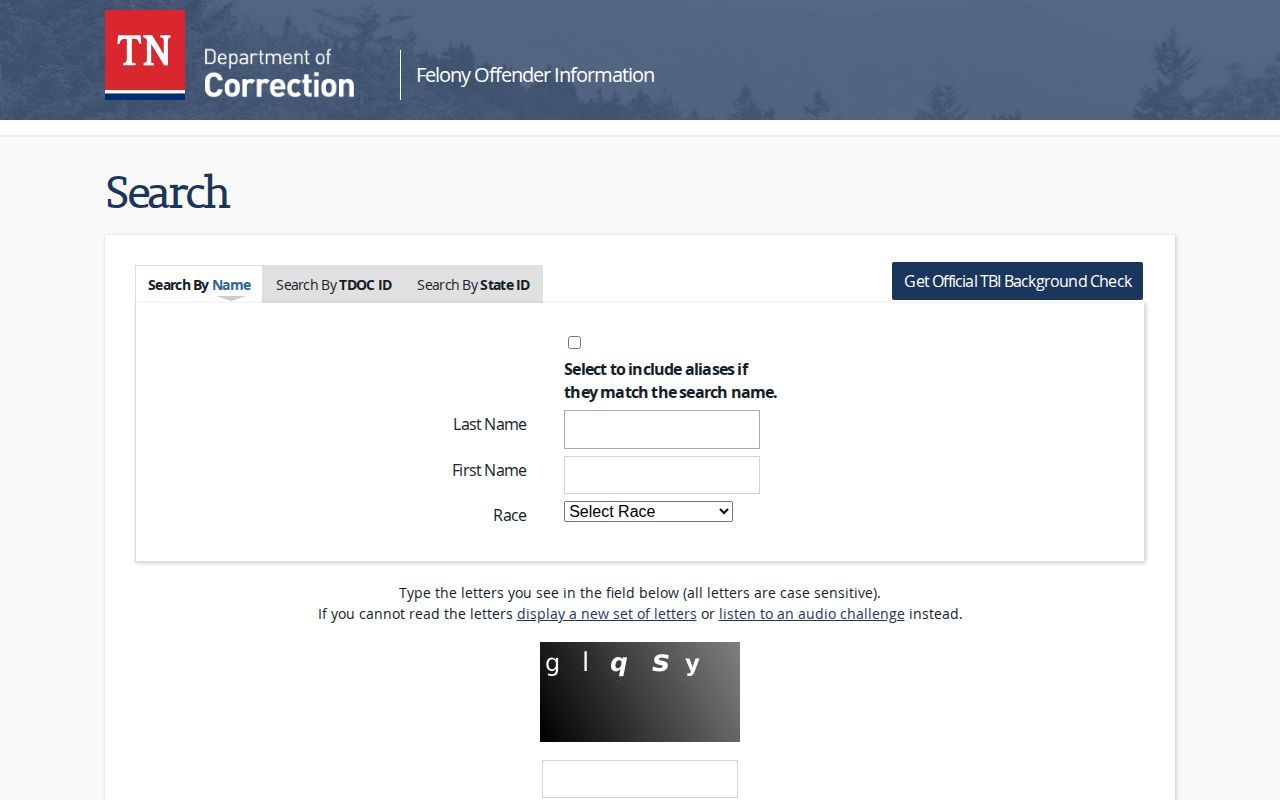
This interface separates name, TDOC ID, and State ID searches, which helps reduce mistaken identity before any release date is interpreted.
| FOIL item | How to read it |
|---|---|
| Status | Incarcerated, parole, probation, or inactive describes the TDOC record state, not a county jail release event. |
| Location | A prison or supervision location helps identify the correct record and current TDOC role. |
| Sentence information | Read offenses, sentence terms, and date labels together rather than isolating one number. |
| Hearing information | A scheduled or completed hearing does not by itself establish release. |
| Release information | Preserve the live label and confirm close questions with the TDOC source record. |
Note: FOIL warns that its information may not be fully current or complete, so the underlying record controls a disputed calculation.
Benton County Release Eligibility Date
RED is the earliest date on which parole may be considered under the rule that applies to the sentence. It is not a Board vote, release authorization, or actual gate date. The Tennessee release-eligibility statute depends on factors such as the offense, offense date, sentence range, classification, and special statutory provisions.
Tennessee has no single rule that all prisoners serve 85 percent. Public Chapter 988 created specified 100 percent and 85-percent-floor groups for covered offenses committed on or after July 1, 2022. Other offenses and older offense dates may follow different rules. A correct calculation therefore starts with the conviction statute and offense date. It must also account for concurrent or consecutive counts, which determines whether sentences run together or one after another.
A Board schedule only shows an event. Hearing officers issue nonbinding recommendations, and Board members make final decisions. A grant may still be followed by release-plan review, conditions, detainer resolution, and TDOC processing. None of those stages should be collapsed into RED.
Benton County Release Credit Rules
Sentence-reduction credits are governed by T.C.A. § 41-21-236 and TDOC policy. The offender handbook describes credits tied to satisfactory conduct and program participation. Credits are earned and retained under set conditions. They are not an automatic fixed subtraction that can be applied to every court sentence.
Disciplinary action can reduce credits, and later restoration may alter a calculation. For some truth-in-sentencing groups, credits may affect privileges or parole timing only within statutory limits and may not reduce the court-imposed expiration date. That is why an eligibility date, safety-valve date, sentence-expiration date, and actual release date must keep their own labels.
No Benton County-specific good-time policy was found for local jail sentences. County calculations may involve the judgment, pretrial jail credit, sentence start, concurrent or consecutive counts, any misdemeanor good-time law that applies, other holds, and administrative processing. The safe route is to obtain the sentencing clerk's judgment and credit order, then ask the jail for the calculation used in that case.
Note: TDOC prison credit rules should not be applied by hand to a Benton County misdemeanor sentence.
Benton County Release Date Changes
A date can move because one of its inputs or legal conditions changes. Some changes affect only parole eligibility. Others affect expiration, physical departure, or the destination after local custody ends. The source of the change should determine where it is checked.
| Factor | Possible effect | Best confirmation |
|---|---|---|
| Earned or forfeited credits | May change an eligible calculation within the applicable law | TDOC sentence computation and credit history |
| Corrected jail credit | Can recalculate the sentence timeline | Court order plus TDOC or jail calculation |
| Concurrent or consecutive counts | Controls whether terms overlap or run one after another | Judgment and sentence record |
| Parole decision | May allow conditional release, deny it, or require further processing | Board decision and TDOC release record |
| Detainer or hold | May redirect the person to another agency instead of the community | Custody release sheet and receiving agency |
| New or amended order | May change the sentence, credit, or release authority | Sentencing court docket |
When two dates conflict, use the record creator for each event. The court controls its judgment. TDOC controls a state sentence calculation. Benton County Jail controls the physical local exit entry. The Board controls its parole decision. Record the conflict rather than silently selecting one source.
Benton County Jail Release Calculations
A pretrial detainee usually has no fixed sentence release date. Release turns on bond, a court order, disposition, another hold, and jail processing. A bond amount does not prove that bond was posted. A dismissed charge does not rule out an unrelated warrant. Ask whether the person remains physically in Benton County custody and, if not, request the release or transfer reason and destination.
A sentenced local inmate may have a calculable end point, but no official Benton County calculator, good-time schedule, weekend-release rule, or processing policy was found. The official jail line is (731) 584-5008. Ask for the correct records custodian before submitting a narrow request. The Circuit Court Clerk can provide the judgment, sentence, jail-credit notation, and later orders that supply the legal inputs.
The county jail record should state the actual event after it occurs. Request the admission and release date and time, release code or reason, releasing authority, and transfer destination. Ask for the code legend. If the record says released to TDOC, ICE, another county, or a federal authority, the movement continued custody.
Benton County Release Computation Quirks
Tennessee's date labels carry distinct legal meanings. Release eligibility is the parole-consideration threshold. Sentence expiration is calculated from the judgment and credits that legally affect it. A safety-valve date applies only where the governing rule creates one. A release authorization documents the approved event. A VINE event reports data supplied by a participating agency.
The 2022 truth-in-sentencing changes make offense date central. A shorthand 85 percent estimate can be wrong because the statute also has specified 100 percent terms and because older or other offenses follow different law. Earned or forfeited credits add another variable. A live FOIL result must therefore retain its exact label instead of being rewritten as a universal projected date.
This distinction is the heart of a sound release date lookup. Identify the law and sentence first. Then ask the proper agency for its calculation. Only after departure should a projected date be compared with the actual custody record.
Confirm Benton County Actual Release
Use the custody agency for final confirmation. For Benton County Jail, request the booking or jail-history entry that states the actual time, reason, authority, and destination. For a state prisoner, read FOIL release information and request TDOC's CR-1947 release authorization or public date-history records when the result is unclear. Archived-offender requests remain available when a former record no longer gives enough public detail.
VINE can supply alerts for a release, transfer, or custody change. The Benton County VINE inmate check explains the person search and notification route. An alert can lag or be corrected, so confirm its source event. If a detainer transferred the person, follow the receiving system. An actual release from one agency does not prove freedom from all custody.
A narrow records request should name the person, include a TDOC, SID, booking, or case number when known, and specify which date is needed. For TDOC, ask for the public sentence-computation history, release or discharge date and type, and CR-1947 authorization. For the county jail, ask for the actual release timestamp, code, authority, and receiving destination. If an abbreviation appears, request the code legend. The court judgment supplies the legal sentence and ordered credit, but the jail or TDOC movement record supplies the physical event. Keeping those roles separate prevents a court disposition date or future sentence date from being reported as the day a person left custody.